

Panorama
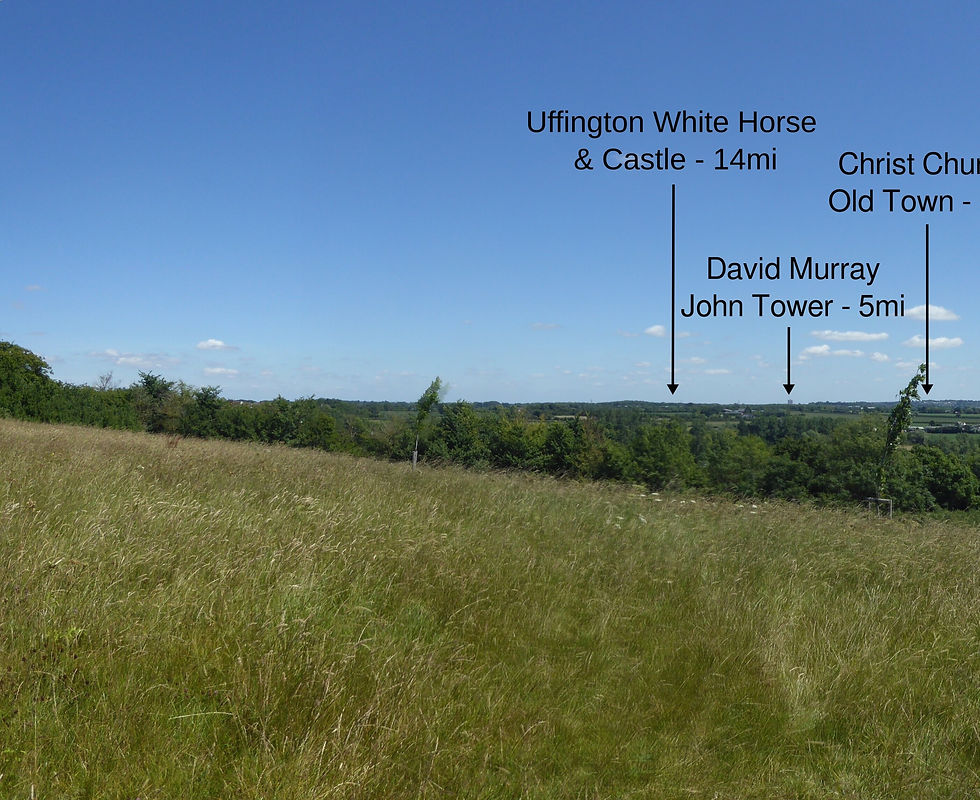


A panoramic photo taken from the viewpoint on Brynards Hill, showing what can be seen on a sunny day.
Uffington White Horse
The Uffington White Horse is a 3,000‑year‑old Bronze Age chalk geoglyph stretching 111 metres across White Horse Hill in Oxfordshire. Although not visible from Brynards Hill, it is Britain’s oldest hill figure — a striking, abstract design thought to represent a tribal symbol, territorial marker, or protective deity.
David John Murray (Brunel) Tower
Often called the Brunel Tower, this is Swindon’s tallest building and a prominent feature on the northern skyline. Standing 83 metres high with 21 floors, it is named after local politician David John Murray, whose post‑war efforts helped attract new industries to the town. Its name also nods to Isambard Kingdom Brunel, founder of Swindon’s railway works.
Christ Church, Old Town
Christ Church is the other major landmark visible on the Swindon skyline. This Grade II listed church on Cricklade Street was built in 1851 to a design by renowned Victorian architect George Gilbert Scott. It remains a focal point of Old Town and an important part of Swindon’s heritage.
Town Hill
Town Hill forms part of the high ground running along the Marlborough Downs. Its open slopes have been used for centuries as grazing land and offer long views across the Vale of the White Horse. The hill sits on ancient chalk downland shaped by farming and settlement since prehistoric times.
Fox Hill
Fox Hill is a prominent ridge on the Ridgeway, one of Britain’s oldest trackways. Overlooking the Vale of the White Horse, it has long served as a natural vantage point for travellers. Its steep slopes and open chalk grassland are characteristic of the North Wessex Downs.
Liddington Hill
Liddington Hill is crowned by Liddington Castle, one of the earliest Iron Age hillforts in Britain. The fort’s earthworks still outline the defensive enclosure used by communities over 2,500 years ago. The hill offers sweeping views across the downs and is closely associated with the ancient Ridgeway.
Bincknoll Castle
Bincknoll Castle is the site of a small Norman motte‑and‑bailey fortification overlooking the Braydon Forest area. Though now reduced to earthworks, its mound and ditches reveal the strategic importance of this spot after the Norman Conquest. The nearby hamlet of Bincknoll takes its name from the same medieval estate.
West Kennet Long Barrow
West Kennet Long Barrow is one of Britain’s largest and best‑preserved Neolithic chambered tombs, built around 3650 BC. Set on a ridge near Avebury, it served as a ceremonial burial place for early farming communities. Visitors today can still enter the atmospheric stone chambers.
Barbury Castle
Barbury Castle is a major Iron Age hillfort on the Ridgeway, occupied from around 600 BC. Its impressive double ramparts enclose a large circular interior, once home to a thriving community. The site later saw use during the Saxon period and today offers panoramic views across the Marlborough Downs.
Hackpen White Horse
Cut in 1838 to commemorate Queen Victoria’s coronation, the Hackpen White Horse sits high on the Marlborough Downs near the Ridgeway. Its compact, upright form is carved into a steep chalk slope, making it clearly visible from the surrounding lowlands.
Broad Town White Horse
Carved in 1864 on a steep 45° slope above Little Town Farm, this is one of Wiltshire’s most animated horses, designed in a lively trotting stance. Visible for miles across the Vale of the White Horse, it has been carefully maintained by volunteers since the 1990s.
King’s Play Hill
A prominent chalk hill rising to around 232 metres, dotted with tumuli, steep scarps and traces of ancient activity. Its open summit gives long views towards Heddington and Roundway Down, with the landscape shaped by prehistoric barrows and later Civil War history.
Cliffe Pypard Wood
An ancient 120‑acre woodland of oak, ash and beech, threaded with quiet trails and spring bluebells. Archaeological traces — including a Bronze Age barrow — sit among ponds, glades and rich wildlife, making it a peaceful pocket of deep rural history
Cherhill White Horse
Cut in 1780 by Dr Christopher Alsop, the Cherhill White Horse is Wiltshire’s second‑oldest chalk horse. It sits dramatically below Oldbury Castle on Cherhill Down, with the Lansdowne Monument nearby. Its steep slope and bold outline make it one of the most striking figures on the A4.
Bowden / Derry Hill
Bowden Hill rises above Lacock with sweeping views over the Avon valley, dotted with woodland, parkland and the 19th‑century Church of St Anne. Nearby Derry Hill sits at the edge of the Bowood estate, a historic village framed by wooded slopes and estate landscapes.
Lyneham Water Tower
A prominent local landmark near Lyneham village, close to St Michael’s Church and the historic settlement of Church End. The tower stands within a landscape shaped by centuries of rural settlement, later transformed by RAF Lyneham and surrounding farmland.
Greenhill Farm
A historic Grade II listed farmstead on the northern edge of Royal Wootton Bassett, characterised by traditional brickwork, stone dressings and a hipped slate roof. It forms part of the older agricultural landscape overlooking the town’s northern approaches.
Great Wood
One of Wiltshire’s largest ancient woodlands, recently restored by the Wiltshire Wildlife Trust. Its wild service trees, ancient oaks, ponds and glades support rare butterflies, birds and woodland species, forming part of a wider nature‑recovery network.
Brynards Hill House
A substantial late‑20th‑century house on the slopes of Brynards Hill, overlooking Royal Wootton Bassett. Set within the historic Brynards Hill landscape, it reflects the area’s transition from farmland to a mix of heritage properties and modern rural homes.